Offloading Knee Braces for Osteoarthritis: A Non-Surgical Option for One-Sided Knee Pain

If you've been told you have knee osteoarthritis, or you're weighing up whether knee replacement surgery is the right next step, it can feel like the choice is between living with pain and going under the knife. Many Australians are surprised to learn there is another option earlier on the treatment ladder: an osteoarthritis knee brace, sometimes called an offloading or unloader brace.
Around 1.2 million Australians live with knee osteoarthritis, and more than 53,500 knee replacements are performed in Australia each year. By 2030, that figure is projected to rise by almost 280 per cent. Yet bracing remains one of the less talked-about conservative management options, even though it features in Australian and international clinical guidance for knee osteoarthritis.
For people whose osteoarthritis affects mainly one side of the knee, an offloading brace is non-invasive, relatively low-cost compared with surgical options, and supported by clinical evidence as a trial intervention that may reduce pain and improve walking function and quality of life. If it doesn't help, it can simply be discontinued.
This guide explains what an offloading knee brace is, what the research evidence says (and where it disagrees), who the brace may suit, and what an assessment and fitting typically involve. It is general education, not a recommendation that bracing is right for any specific person. Whether bracing is appropriate for your situation is something only a clinical assessment can determine.
Key Takeaways
- An osteoarthritis knee brace, or offloading brace, is designed to redirect weight-bearing load away from the painful side of the knee joint
- Bracing is suitable for unicompartmental knee osteoarthritis of mild to moderate severity, where pain comes mainly from the medial (inner) or the lateral (outer) compartment of the knee
- Randomised trials suggest some people experience reduced pain and improved walking function over weeks to months of consistent wear
- Clinical guidance is mixed: ACR strongly recommends knee bracing in osteoarthritis; OARSI withdrew its earlier recommendation citing inconclusive evidence
- Bracing is a non-surgical option that may suit some people; for others, total knee replacement remains the most appropriate treatment

What Is Knee Osteoarthritis?
Knee osteoarthritis is a condition in which the smooth cartilage that cushions the bones inside your knee gradually wears down. As cartilage thins, the bones that meet at the knee joint move with less protection, which can cause pain, stiffness, swelling, and a feeling that the knee "catches" or "gives way" during everyday movement.
The knee has three compartments: the medial compartment on the inside of the knee, the lateral compartment on the outside, and the patellofemoral compartment behind the kneecap. In Australia, medial compartment osteoarthritis is the most common pattern, particularly in adults over 50 and in people whose legs naturally tend toward a "bow-legged" alignment that loads the inside of the joint more heavily. Lateral compartment osteoarthritis is less common but follows a similar logic in reverse, and is more often seen in people whose alignment tends toward "knock-knee". When osteoarthritis is confined to a single compartment, medial or lateral, it is described as unicompartmental, and this is the pattern most relevant to offloading bracing.
Knee osteoarthritis is typically diagnosed through a combination of clinical examination, a discussion of your symptoms and activity limitations, and imaging such as a weight-bearing X-ray. Severity is sometimes graded using the Kellgren-Lawrence scale (I to IV) or the Ahlbäck scale, which describe how much joint space has narrowed and how much bony change has occurred.
The Treatment Ladder for Knee Osteoarthritis
The Australian Commission on Safety and Quality in Health Care publishes an Osteoarthritis of the Knee Clinical Care Standard that sets out evidence-based recommendations for managing knee osteoarthritis in Australia. The standard emphasises a stepped, conservative-first approach.
Conservative management typically includes:
- Education about the condition and what to expect
- Exercise programmes, particularly quadriceps and hip strengthening, often delivered by a physiotherapist
- Weight management, since each kilogram of body weight carried translates to roughly four kilograms of additional load through the knee with each step
- Pharmacological options prescribed by a GP, ranging from paracetamol and topical anti-inflammatories to other options as clinically appropriate
- Orthotic and bracing options, including offloading knee braces and supportive footwear modifications
- Activity modification and pacing strategies
Surgery, when it is appropriate, sits at the top of the ladder. Total knee replacement is highly effective for end-stage osteoarthritis. Partial knee replacement may suit some people with single-compartment disease. Notably, knee arthroscopy for osteoarthritis (sometimes called "keyhole" surgery to clean out the joint) is now rarely recommended; the rate of arthroscopy in Australians over 45 fell by approximately 47 per cent between 2015 and 2022 because the evidence shows it does not improve pain or function for osteoarthritis.
Offloading knee braces are one of the less well-known rungs on this ladder, even though they have been studied in randomised controlled trials and are recommended in some clinical guidelines.
What Is an Osteoarthritis Knee Brace?
An osteoarthritis knee brace, or offloading knee brace, is a hinged knee orthosis designed to apply a controlled corrective force across the knee joint. The aim is to shift weight-bearing load away from the painful compartment and toward the healthier compartment. The same style of brace can be configured to unload either the medial (inner) or the lateral (outer) side, depending on which compartment is affected; medial offloading is more common simply because medial-side osteoarthritis is more common.
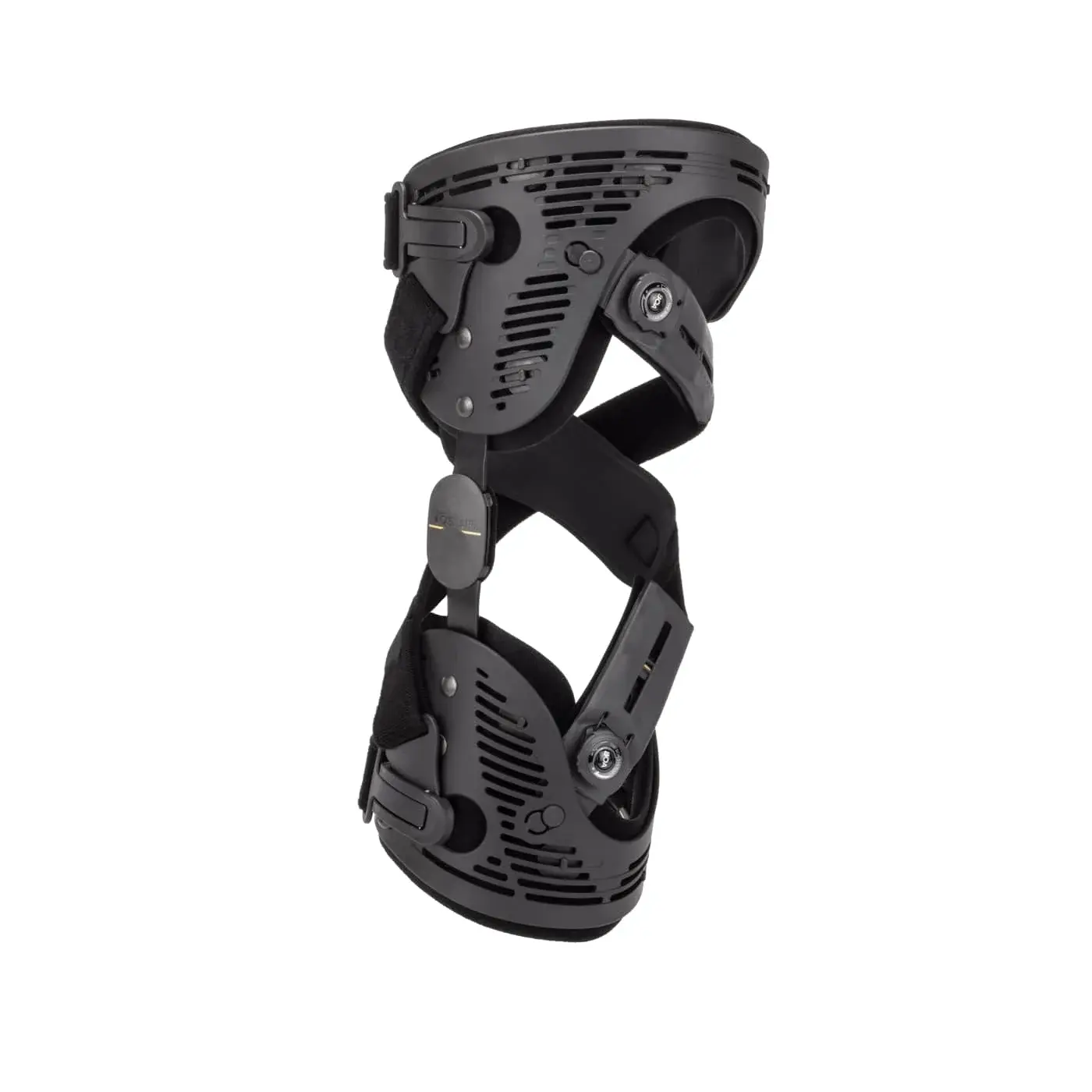
Most modern offloading braces use a three-point pressure system: pads or hinges on either side of the knee work together to apply a gentle outward force on the painful compartment with each step. Some designs use adjustable straps that engage during knee extension to actively unload the joint as you walk. The Össur Unloader One, an offloading knee brace with a notable body of clinical research behind it, uses adjustable Dynamic Force Strap technology and is one example of this style of device. Other manufacturers produce comparable braces.
The purpose of the brace is not to "treat" the underlying osteoarthritis; cartilage damage cannot be reversed by a brace. The purpose is to reduce the pain experienced when bearing weight, which for many people translates to longer walking tolerance, more comfortable participation in everyday activities, and the ability to remain active.
What the Evidence Says About Osteoarthritis Knee Braces
Bracing for knee osteoarthritis has been studied for decades, and the evidence base is encouraging without being unanimous. Honest framing matters here, because the studies do not all point the same way.
Wilson et al. (2018), BMC Musculoskeletal Disorders
A randomised, placebo-controlled trial of 149 participants with mild to moderate knee osteoarthritis (Ahlbäck grade I–II) compared an active unloader brace against a sham brace where the unloading mechanism had been removed. Differences between groups were not yet apparent at six weeks, but the active brace group showed improved Knee Society Scores at six and twelve months. The researchers noted that benefits may take time to emerge as users adapt to wearing the brace.
The ROTOR Randomised Trial (2018), Scientific Reports
This trial compared unloader bracing plus usual care against usual care alone in symptomatic knee osteoarthritis. Participants in the bracing group reported greater improvements in pain and physical function over the study period.
The ERGONOMIE Randomised Trial (2021), Osteoarthritis and Cartilage
A larger randomised study evaluated effectiveness, safety, and cost-utility of bracing in medial knee osteoarthritis, supporting bracing as a clinically and economically reasonable option in the conservative management of medial compartment disease.
Where Guidelines Disagree
The American College of Rheumatology's 2019 guideline strongly recommends knee bracing in the management of knee osteoarthritis. The Osteoarthritis Research Society International (OARSI), in contrast, withdrew its earlier recommendation in its 2019 update, citing what its committee considered inconclusive evidence for symptomatic benefit. This divergence reflects a genuine reality in the literature: response to bracing varies considerably between individuals, and not everyone benefits.
Important: Studies suggest that benefits from offloading knee braces typically emerge over six weeks to six months of consistent daily wear, not immediately. Patience and regular use during weight-bearing activities are key to seeing whether bracing works for you.
The honest summary: research suggests offloading knee braces may reduce pain and improve walking function for some people with unicompartmental knee osteoarthritis. Most published trials have focused on medial-compartment disease (which is more common), though the same braces are also used for lateral-compartment osteoarthritis with the unloading direction reversed. Individual response varies, and a trial period of wear is often the only way to know whether the brace will help you specifically.
Who May Benefit From an Osteoarthritis Knee Brace?
An offloading knee brace is not appropriate for every person with knee pain, and a clinical assessment is essential to determine suitability. That said, the indications and contraindications are reasonably well-established.
Bracing may be suitable for people who:
- •Have unicompartmental knee osteoarthritis confined mainly to the medial or the lateral compartment, confirmed clinically and on imaging (medial-compartment disease is more common, but lateral-compartment OA can also be braced with the unloading direction reversed)
- •Have mild to moderate disease severity (typically Kellgren-Lawrence grade II or III)
- •Are active adults wanting to maintain or return to walking, hiking, golf, gardening, or work that involves standing
- •Are not yet candidates for knee replacement surgery, or wish to delay surgery if possible
- •Cannot currently undergo surgery for unrelated medical reasons but want to remain mobile
Bracing may not be suitable for people who:
- •Have severe end-stage osteoarthritis (Kellgren-Lawrence grade IV, often described as "bone on bone")
- •Have bicompartmental or tricompartmental osteoarthritis, where there is no healthier compartment to direct load toward
- •Have knee instability from ligament injury that would require a different style of brace
- •Have skin conditions, significant leg shape variation, or other factors that make a comfortable, secure fit unlikely
Important: Bracing and surgery are not opposing choices. For some people, an offloading knee brace may help delay or avoid the need for surgery. For others, total knee replacement remains the most appropriate treatment. These decisions should be made with your GP, orthopaedic surgeon, and a qualified orthotist who can assess your specific situation.
What to Expect From an Assessment and Fitting
If your GP, physiotherapist, or surgeon has suggested an offloading knee brace might be worth exploring, an assessment with a qualified orthotist is the next step.
1. Initial Consultation
The first appointment is usually an information-gathering session. Your orthotist will:
- •Review your medical history, current symptoms, and activity goals
- •Look at any imaging you have available (a recent weight-bearing X-ray is particularly helpful)
- •Examine your knee, looking at alignment, range of motion, ligament stability, and skin condition
- •Watch you walk to understand your gait pattern and how the knee behaves under load
- •Discuss what you are hoping to achieve and whether bracing is likely to help
If bracing is a reasonable option, you and your orthotist will discuss the available styles. Most osteoarthritis knee braces are off-the-shelf devices that come in a range of sizes and adjustable components, though custom options exist for people whose anatomy or needs require them.
2. Measurement and Sizing
The orthotist takes circumferential and length measurements at several points along your leg to select the correct size. Some braces also require side-specific configuration depending on which compartment of your knee is being unloaded.
3. Fitting Appointment
At the fitting, the brace is applied and the orthotist:
- •Checks alignment of the hinges and unloading mechanism against your knee joint line
- •Adjusts strap tension, hinge positioning, and any padding to balance unloading effect with comfort
- •Has you walk in the brace and watches for any rubbing, slipping, or uneven loading
- •Provides clear instructions on how to put the brace on, take it off, and care for it
- •Sets a wearing schedule, typically starting with shorter periods and building up over the first one to two weeks
4. Trial Period and Follow-Up
A follow-up appointment is usually scheduled four to six weeks after fitting. By that point, most people have a reasonable sense of whether the brace is helping, where it is uncomfortable, and what adjustments are needed. Strap tension and hinge angles can often be fine-tuned at this stage to improve both comfort and unloading effect.
Living With an Offloading Knee Brace
An offloading knee brace is not generally worn 24 hours a day. Most people wear the brace during weight-bearing activities, walking, standing, working, exercising, and remove it when sitting or sleeping.
There is an adjustment period. The brace can feel bulky at first, and the skin under the straps may need a few weeks to acclimatise. Most people settle in within two to four weeks; a smaller number find that, despite a good fit, the brace is not comfortable enough for sustained use, which is a valid finding to discuss with your orthotist.
Day-to-day points worth knowing:
- Wear the brace over a thin layer of clothing or a brace sleeve to reduce skin irritation
- Inspect your skin daily, particularly in the first month, for any redness or rubbing
- Keep the straps and pads clean according to the manufacturer's instructions
- Replacement straps and pads typically last between one and three years depending on use; the brace itself often lasts three to five years
- The brace works best as part of a programme, not in isolation, alongside exercise, weight management, and any care your GP or specialist has recommended
Costs and Funding for Knee Bracing in Australia
Cost depends on the specific brace prescribed and whether it is off-the-shelf or custom. Off-the-shelf offloading knee braces from established manufacturers typically sit in the mid-to-upper hundreds of dollars range. Custom braces are more, sometimes substantially so. Your orthotist can provide specific pricing once they have assessed which device suits you.
Funding pathways available in Australia include:
- Private health insurance: Many extras policies cover knee bracing under "orthotics" or "appliances". Rebate amounts and waiting periods vary considerably between insurers and policy levels, so check directly with your fund.
- NDIS: NDIS funding for knee osteoarthritis bracing is uncommon, because age-related osteoarthritis is generally not the disability for which a participant has a plan. In specific cases where bracing supports plan goals, it may be considered. For a detailed overview of NDIS, QALS, and DVA pathways, see our funding guide.
- DVA: Veterans with eligible service-related conditions affecting the knee may have funding pathways available through the Department of Veterans' Affairs.
- WorkCover or compensable claims: If your knee condition relates to a work injury, your insurer may fund bracing as part of management.
- Self-funded: Many people pay privately. Compared with the cost and recovery time of surgery, a trial of bracing is a relatively modest investment to establish whether the approach helps you.
How Bracing Fits Alongside Other Conservative Care
The strongest evidence for managing knee osteoarthritis sits with a programme of care, not any single intervention. An offloading knee brace tends to work best when it is one part of a broader plan that may include:
- A physiotherapy-led exercise programme focused on quadriceps, hip, and core strength, since stronger muscles around the knee share the load and improve joint stability
- Weight management, given the load-multiplying effect of body weight through the knee
- Pain management as advised by your GP, including topical and oral options where appropriate
- Activity modification to reduce flares without retreating from movement altogether
- Footwear and foot orthotics where lower-limb alignment is contributing to knee load (related: custom orthotics guide)
Working with a multidisciplinary team, GP, physiotherapist, orthotist, and where appropriate an orthopaedic surgeon, tends to produce better outcomes than any single discipline working alone.
How Align's Knee Bracing Service Works
Align Prosthetics provides knee bracing assessment and fitting as part of our orthotic services across the Sunshine Coast and South East Queensland. The service includes a clinical consultation reviewing your history and imaging, discussion of whether bracing is suitable for your situation, fitting of an appropriate off-the-shelf or custom device, and follow-up review. Where private health insurance, DVA, or WorkCover funding applies, we can support the documentation needed.
Frequently Asked Questions
Can a knee brace really help osteoarthritis pain, or is it just expensive support?▼
Research suggests that, for people with unicompartmental knee osteoarthritis of mild to moderate severity, offloading knee braces may reduce pain and improve walking function over weeks to months of consistent wear. Most of the published trials have focused on medial-compartment disease (which is the more common pattern), though the same braces are also used for lateral-compartment osteoarthritis with the unloading direction reversed. Studies including a placebo-controlled randomised trial have shown benefits beyond a non-functional brace, indicating the unloading mechanism contributes to the effect rather than just the brace's presence on the leg. That said, response varies, and clinical guidelines are not unanimous: the American College of Rheumatology strongly recommends knee bracing in osteoarthritis, while OARSI considers the evidence inconclusive. A clinical assessment is the best way to gauge whether bracing is likely to help in your specific case.
Will an offloading knee brace let me avoid knee replacement surgery?▼
Bracing may delay the need for surgery for some people, particularly those with mild to moderate unicompartmental osteoarthritis who are not yet candidates for knee replacement. It does not guarantee that surgery can be avoided, and for end-stage osteoarthritis a knee replacement may still be the most appropriate option. Bracing and surgery are not opposing choices; they are different rungs on the conservative-to-surgical management ladder. Decisions about whether and when to pursue surgery should be made with your GP, orthopaedic surgeon, and orthotist together.
How long does it take for an osteoarthritis knee brace to start working?▼
Studies suggest that benefits typically emerge over six weeks to six months of consistent daily wear during weight-bearing activities, not immediately. The Wilson 2018 placebo-controlled trial, for example, did not see clear differences at the six-week mark but did show improvement in the active brace group at six and twelve months. Patience and a willingness to wear the brace consistently through a trial period are important. If after a few months of regular use you are not noticing improvement, that is also useful information to bring back to your orthotist, GP, or orthopaedic surgeon so the next step in your management can be discussed.
Are osteoarthritis knee braces covered by Medicare or NDIS in Australia?▼
Medicare does not generally cover the cost of knee bracing for osteoarthritis. NDIS funding for knee osteoarthritis bracing is uncommon because age-related osteoarthritis is typically not the disability for which a participant has a plan, though there are case-by-case exceptions. Most people who fund bracing privately do so through their private health insurance extras cover (under orthotics or appliances), or pay out of pocket. Veterans may have access to DVA funding for service-related conditions, and WorkCover may apply if the knee issue is work-related. Check directly with your insurer or scheme for specifics.
How do I know if I'm a good candidate for an offloading knee brace?▼
The clearest indication is unicompartmental knee osteoarthritis of mild to moderate severity, where pain is coming mainly from the medial (inner) or the lateral (outer) compartment, in an active adult who wants to maintain or return to walking, work, or recreational activity. People with severe end-stage osteoarthritis, bicompartmental or tricompartmental disease, significant knee instability, or skin conditions that prevent a comfortable fit are generally less suitable. The most reliable way to find out is a clinical assessment with a qualified orthotist, ideally with a recent weight-bearing X-ray of your knee available, so the brace can be matched to the actual pattern of your osteoarthritis rather than to symptoms alone.
Disclaimer: Individual results vary. This article is educational and does not replace professional medical advice. Knee osteoarthritis management decisions, including whether bracing is appropriate for your situation, should be made in consultation with your GP, orthopaedic surgeon, and a qualified orthotist.
Align Prosthetics provides osteoarthritis knee brace assessment, fitting, and follow-up as part of our orthotic services across the Sunshine Coast and South East Queensland.
Book a Knee Bracing Assessment